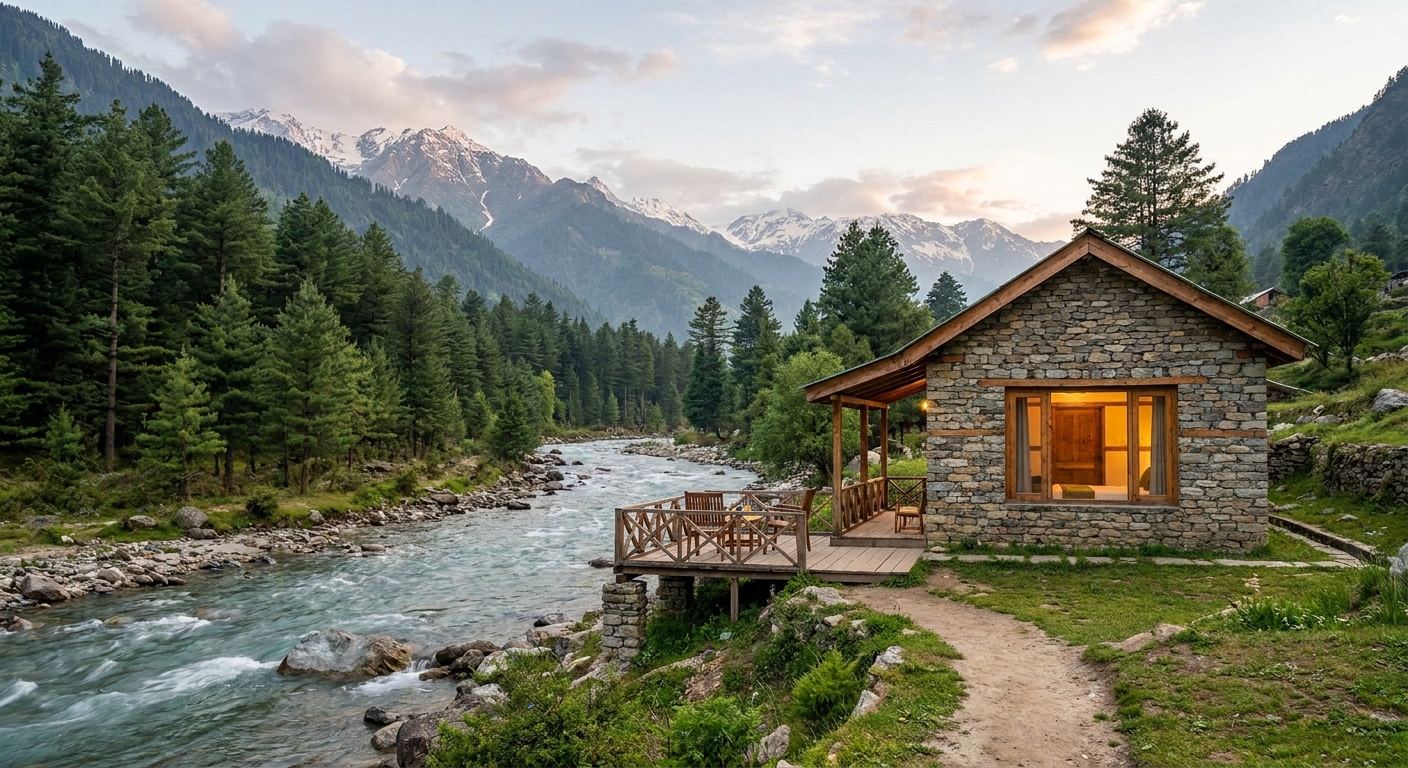
Booking a riverside homestay in Himachal Pradesh sounds simple until you realize half the listings calling themselves "riverside" are actually a 15-minute walk from the water. This guide breaks down exactly how to book one that's genuinely on the bank, in 2026, without getting stuck with a mountain-view room that just borrowed the river's name.
- Confirm exact distance to water in meters, not the word "riverside" — anything past 100m is a stretch.
- Tirthan and Parvati valley homestays sit closest to the water; Beas-side stays near Manali see heavier monsoon swelling.
- Book through Homeyhuts for zero commission and instant confirmation direct from the host, no markup added.
- Avoid booking riverside stays in Himachal Pradesh during July-August when water levels rise fast.
- Winter (Dec-Feb) gives the calmest river views but check road access to Jibhi and Kasol first.
Why this matters
Himachal Pradesh has four river systems that homestays cluster around — the Beas near Manali and Kullu, the Parvati near Kasol, the Tirthan near Jibhi and Gushaini, and the Satluj further south near Rampur. Each has a different personality: the Beas runs fast and wide, the Tirthan stays clear and shallow enough to wade in during autumn, and the Parvati carries a colder, glacial edge even in summer.
The difference matters because "riverside" gets used loosely in listing titles. A homestay 300 meters uphill with a partial river glimpse gets marketed the same way as one where the deck hangs over the water. Booking the wrong one means paying for a sound you can't actually hear.
What you'll need
- A target river valley — Tirthan, Parvati, Beas, or Satluj
- Travel dates matched to season (monsoon vs. winter vs. shoulder season)
- A verified listing on a platform like Homeyhuts that shows exact location, not just a valley name
- Photos or a video call with the host confirming the water view from the room, not just the property
- A backup homestay option in the same valley in case road access changes
The steps
1. Pick your river valley first, then narrow to a village
Deciding on "Himachal Pradesh" is too broad — decide on a valley. The Tirthan Valley around Gushaini and Banjar sits at roughly 1,600 meters and stays cooler with a slower current than the Beas. The Parvati Valley near Kasol runs colder and faster, popular with trekkers headed toward Kheerganga.
Once you've picked the valley, narrow to a village on that river. Gushaini, Nagini, and Jibhi all sit on or near the Tirthan; Kasol, Chalal, and Tosh sit along the Parvati. This single decision cuts your search by 80%.
Common mistake: picking a district name ("Kullu") instead of a river valley, which returns homestays scattered across four different water bodies.
2. Check the water-facing claim before you book
Ask for the exact distance from the property to the riverbank — in meters, not adjectives. A genuine riverside homestay sits within 50-100 meters, close enough to hear the water at night. Anything the host describes as "near the river" without a number usually means a 10-15 minute walk.
Request a photo taken from the room or the balcony, not a stock shot of the river from somewhere on the property. If the host can't produce that in 2026, when every phone shoots decent video, that's a signal to move on.
3. Match the season to the river you want
River character changes drastically by month. Between June and September, monsoon runoff swells the Beas and Parvati, and water can run brown and fast enough that homestays fence off direct access for safety. October through November gives the clearest, calmest water across all four valleys.
December through February drops temperatures near freezing at higher elevations like Jibhi, but the river runs low and clear, and snowfall around the valley adds a second reason to book. If you want swimmable water, target April-May before the melt picks up, or October after the monsoon settles.
4. Confirm road access and last-mile connectivity
Riverside homestays often sit at the end of narrow, unpaved roads that regular cabs won't take, especially near Gushaini and Tosh. Ask the host directly whether a sedan can reach the property or if the last stretch needs a local taxi or a 10-15 minute walk with luggage.
During monsoon and heavy winter snow, some access roads close entirely for days. Build a one-day buffer into your travel plan for valleys above 2,000 meters between December and February.
Common mistake: booking a non-refundable cab in advance for a road that gets seasonally blocked.
5. Verify the host and read recent reviews, not just the average rating
A 4.8 rating built on reviews from three years ago tells you less than five reviews from the last two months. Look specifically for mentions of river noise, water clarity, and how close the actual room is to the bank — guests who booked a riverside stay usually mention it explicitly if the claim held up.
On a platform like Homeyhuts, listings show verified host status and direct contact, so you can message before booking to confirm details a review might miss, like current water levels or whether the deck is currently accessible.
6. Lock the booking with instant confirmation
Once the location and season check out, book immediately rather than holding the listing. Riverside properties in Tirthan and Parvati valleys are a small inventory — often single-digit counts of genuinely water-adjacent homestays per village — and they fill fast around long weekends and the October-November shoulder season.
Booking direct through a zero-commission platform means the price you see is the price you pay, with no markup layered on top for the booking channel. Instant confirmation also removes the back-and-forth wait that can cost you the room to someone else.
7. Pack for river-adjacent weather swings
Riverside spots run 3-5 degrees cooler at night than the nearest town center because of the water and elevation combined. Pack a warm layer even for summer trips to Tirthan or Parvati, and waterproof footwear if you're visiting between June and September when banks get muddy.
Expected outcome: you arrive at a property where the river is visibly and audibly close, the road access matched what the host described, and the season lines up with what you wanted to see or do at the water.
Troubleshooting
The listing said "riverside" but the room doesn't face the water. Message the host before arrival day and ask for reassignment to a water-facing unit if the property has more than one room; if it's a single-unit homestay, request a refund or reschedule based on the platform's stated terms.
Road to the property is closed due to weather. Ask the host for the nearest drop point and whether local transport (jeep or taxi) can bridge the last stretch — this is common in Jibhi and Tosh during heavy snow or monsoon runoff.
No mobile signal at the property. Confirm this with the host ahead of time rather than on arrival; many Tirthan and Parvati valley homestays run on limited network and rely on landline or Wi-Fi calling only.
River level looks too high or too fast to enjoy. This is expected during peak monsoon (July-August); reschedule toward October-November or April-May if river access is the main reason for the trip.
Photos don't match what you see on arrival. Document it immediately with your own photos and raise it with the host and the booking platform the same day — waiting until checkout weakens your case.
Tools and resources
- A verified listings platform that shows exact location and host contact, not just a valley name
- Local weather and road-status checks for the specific village 48 hours before travel
- A backup homestay shortlist in the same valley
- For couples specifically hunting river-adjacent stays, tree houses in Jibhi built for a getaway sit directly along the Tirthan and are worth comparing against ground-floor riverside rooms
Book a verified riverside stay
Compare host-verified homestays across Himachal with zero commission and instant confirmation.
What to do next
If the river is a backdrop to a bigger trip rather than the main event, look at options built around the occasion instead of just the water. Himachal homestays picked for a mountain honeymoon cover several valleys and filter for privacy and views, which often overlaps with genuine riverside placement.
FAQ
What's the best river valley for a riverside homestay in Himachal Pradesh?
Tirthan Valley near Gushaini and Jibhi has the highest concentration of homestays sitting within 50-100 meters of the water. Parvati Valley near Kasol is a close second, though the current runs colder and faster.
Is a riverside homestay in Himachal Pradesh better than a hotel for river views?
Homestays generally sit closer to the bank than hotels, which tend to cluster near town centers. In 2026, most genuine riverside properties in valleys like Tirthan are homestays, not hotel chains.
How much does a riverside homestay in Himachal Pradesh cost?
Pricing varies by valley, season, and property size, so check current rates directly on the listing rather than relying on a fixed figure. Peak season (October-November, December-February) runs higher than monsoon months.
When is the best time to book a riverside homestay near the Tirthan or Parvati river?
October through November and April through May give the clearest, calmest water. Avoid July-August when monsoon runoff swells both rivers and access to the bank often gets restricted.
Do riverside homestays in Himachal Pradesh have good road access?
Access varies sharply by village — Kasol and Manali-area stays have paved roads, while Gushaini and Tosh often need the last stretch covered by local taxi or on foot. Confirm with the host before booking, especially in winter.
Can I book a riverside homestay in Himachal Pradesh with zero commission?
Yes — platforms like Homeyhuts list homestays direct from hosts with no commission markup, so the listed price is what you pay. Instant confirmation also avoids the wait time some booking channels add.
Is it safe to stay right on the river during monsoon season in Himachal Pradesh?
Water levels rise fast between June and September, and some homestays restrict direct riverbank access during this window for safety. Winter and shoulder-season months (October-November, April-May) are safer for close-to-water stays.
What should I check before booking a homestay advertised as riverside?
Ask for the exact distance to the water in meters and a photo taken from the room itself, not a general property shot. Read reviews from the last two months specifically mentioning river proximity and noise.
One last thing
The closest genuine riverside stays in Himachal Pradesh in 2026 aren't in the well-known towns — they're in smaller Tirthan Valley villages like Gushaini and Nagini, where a handful of homestays sit close enough that you can hear the current from bed. Manali and Kasol get the search volume; the actual riverbank real estate is further off the main road.